Why E-Commerce Sellers Should Expand to Europe in 2026
 VATAi Team
For e-commerce sellers looking to scale their business globally, the question is no longer if you should expand internationally, but where. While many brands look toward emerging markets, the data points to a clear, mature, and highly lucrative opportunity: Europe.
With a massive consumer base, near-universal internet penetration, and a deep-rooted culture of cross-border shopping, the European e-commerce market is primed for international sellers. Whether you are based in North America, Asia, or elsewhere, 2026 is the year to make your move.
Here is a data-driven look at why expanding to Europe should be at the top of your e-commerce strategy.
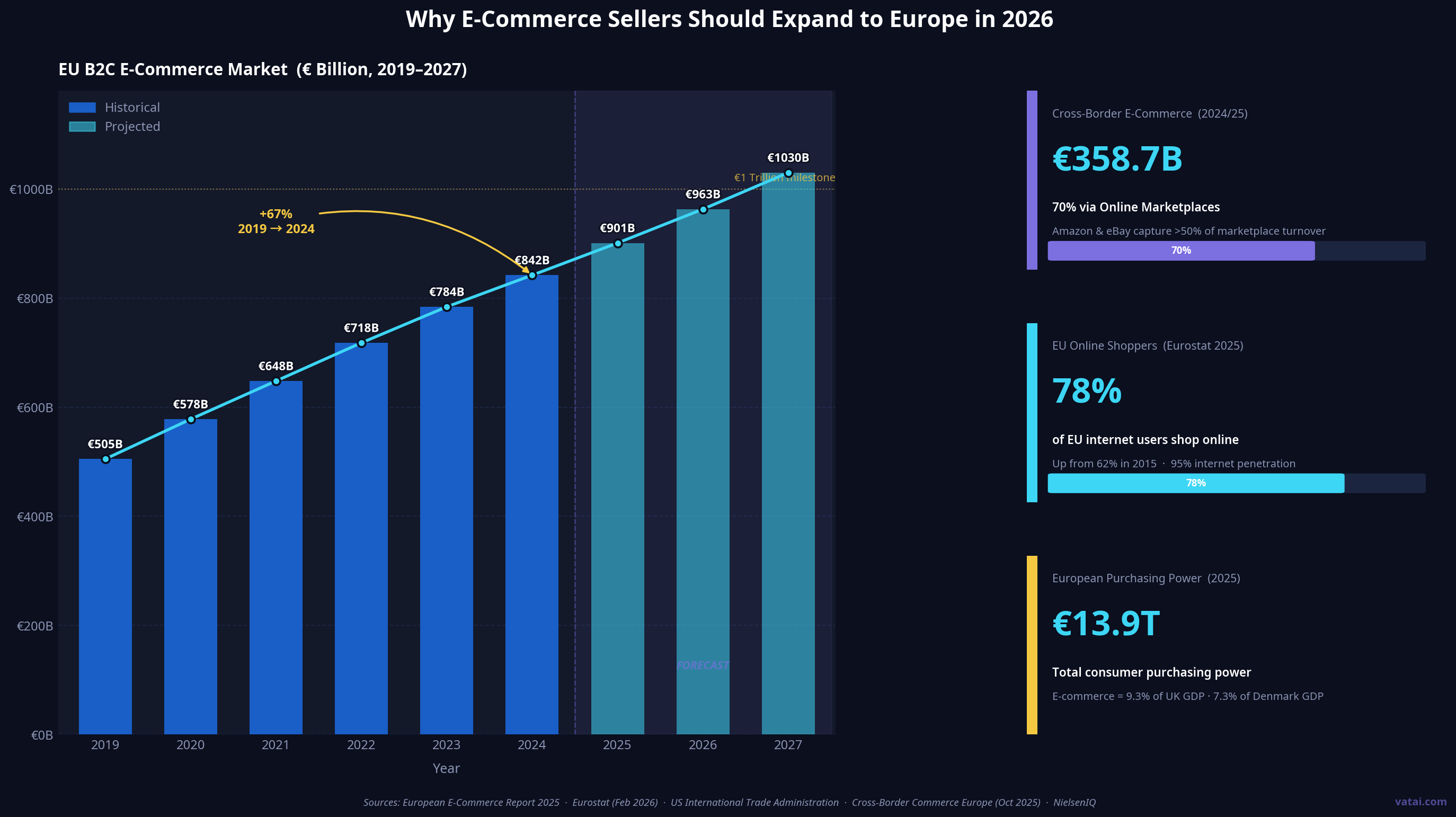
1. A Market Approaching €1 Trillion
The European e-commerce landscape is not just large; it is consistently growing. In 2024, the total B2C European e-commerce turnover reached €842 billion, representing a 7% nominal increase from the previous year.
This growth trajectory is expected to continue. Forecasts project that European retail e-commerce sales will reach an astonishing US$902.3 billion by 2027, driven by an annual growth rate of 9.31%. This makes Europe the third-largest retail e-commerce market globally, offering a scale that few other regions can match.
Top European E-Commerce Markets (2024 Turnover):
| Country | E-Commerce Turnover |
| France | €175.3 billion |
| United Kingdom | €150.0 billion |
| Spain | €95.2 billion |
| Germany | €94.0 billion |
Source: European E-Commerce Report 2025
2. A Culture of Cross-Border Shopping
One of the biggest hurdles in international expansion is convincing consumers to buy from a foreign entity. In Europe, this barrier is remarkably low. European consumers are highly accustomed to cross-border shopping, actively seeking out international brands for better prices, unique products, and broader selections.
In 2024/2025, the European cross-border e-commerce market reached a staggering €358.7 billion. Even more compelling for international sellers is that 70% of this cross-border turnover (€247.5 billion) was generated by online marketplaces.
If you are already selling on platforms like Amazon, eBay, or Etsy, the infrastructure to reach European consumers is already in place. In fact, 98.2% of marketplace visitors in Europe are forecasted to be cross-border shoppers in 2026.
3. High Internet Penetration and Digital Trust
Europe boasts some of the highest internet and online shopping adoption rates in the world. In 2024, internet penetration across the continent reached 93%, and it is expected to hit 94% by 2025—approaching universal coverage.
More importantly, these internet users are active shoppers. According to Eurostat data from early 2026, 78% of individuals in the EU who used the internet in the previous 12 months bought or ordered goods and services online. This is a significant jump from 62% just a decade ago.
Furthermore, the European digital ecosystem is built on trust. A robust 63% of EU e-shoppers reported encountering zero problems when purchasing online. When consumers trust the payment gateways, delivery networks, and consumer protection laws, they are far more likely to click "Buy Now" on an international storefront.
4. Strong Purchasing Power
Volume is only half the equation; purchasing power is the other. European consumers have significant disposable income. In 2025, Europeans are projected to have a total purchasing power of approximately €13.9 trillion.
This economic strength translates directly into e-commerce spend. In countries like the UK and Denmark, e-commerce accounts for 9.3% and 7.3% of the national GDP, respectively, demonstrating how deeply integrated online shopping is into the daily lives and economies of European nations.
5. The "Marketplace First" Advantage
For global sellers, entering a new market often means building brand awareness from scratch. However, Europe's reliance on marketplaces offers a shortcut.
As noted earlier, marketplaces drive 70% of cross-border sales in Europe. Giants like Amazon and eBay capture over half of this marketplace-driven turnover. By leveraging these established platforms, international sellers can bypass the need for extensive localized marketing campaigns and immediately tap into a massive, high-intent customer base.
6. Selling to Europe Requires the Right Compliance Setup (VATAi is Your All-in-One Compliance Parnter)
Europe offers huge e-commerce potential, but market entry is not only about demand, logistics, and marketplace access. For non-EU and EU sellers alike, compliance is a core part of sustainable growth.
Before selling into Europe, e-commerce businesses should assess several key obligations:
VAT Compliance
If you store goods in Europe, import products into the EU, or sell cross-border to EU consumers, VAT registration and filing may be required. For some B2C cross-border sales, the EU’s One Stop Shop (OSS) can simplify reporting by allowing businesses to declare VAT in one Member State for eligible EU-wide sales.
EPR Obligations
In many European countries, sellers may need to register for Extended Producer Responsibility (EPR) for categories such as packaging, WEEE, and batteries, depending on the products they place on the market. These obligations are country-specific and can apply before products are sold.
Product Safety Requirements
The EU General Product Safety Regulation (GPSR) has applied since 13 December 2024 and strengthens product safety requirements for consumer products sold in the EU. Depending on the product and sales model, sellers may need to ensure proper operator information, traceability, labeling, and documentation.
Packaging compliance is becoming more important
The EU Packaging and Packaging Waste Regulation (PPWR) is raising the bar for packaging compliance across the region, and sellers should prepare early for packaging-related obligations and national registration requirements where applicable.
For global e-commerce sellers, the takeaway is simple: Europe is one of the most attractive regions for expansion, but compliance should be built into your market-entry strategy from the start. Getting VAT, EPR, and product compliance right early can help you avoid delays, marketplace issues, and unnecessary operational risk.
Scale into Europe with Confidence
Europe is full of opportunity for e-commerce sellers, but growth works best when compliance is handled early and correctly. VATAi supports global sellers with end-to-end e-commerce compliance solutions, including VAT, EPR, Authorised Representative, trademark, and more — helping businesses expand across Europe with greater clarity and less friction. Talk to VATAi today and build your Europe expansion plan with confidence.
Conclusion: The Time is Now
Expanding into Europe in 2026 offers e-commerce sellers a rare combination of massive scale, high purchasing power, and a consumer base that actively embraces cross-border trade. With a market approaching €1 trillion and established marketplace infrastructure ready to be utilized, the barriers to entry are lower than ever.
If you want to scale your e-commerce business globally, Europe is not just an option—it is a necessity.
References
[1] European E-commerce Report 2025 (Executive Summary)
[2] European Retail eCommerce - International Trade Administration
[4] E-commerce statistics for individuals - Eurostat [5] NIQ Purchasing Power Europe 2025 - NielsenIQ
Need Help with E-Commerce Compliance?
Book a free call with VATAi today to find tailored solutions for your e-commerce business! VAT | EPR | AR | Trademark & more
