German WEEE Compliance Guide: What Cross-Border Sellers Need to Know
 VATAi Team
Do you need a WEEE registration to sell desk lamps, routers or coffee machines in Germany? Start with two questions. Does your product fall within the scope of Germany’s electrical and electronic equipment rules, and who is responsible for placing it on the German market?
This guide explains how to check, how to register and what to do once you have your WEEE number.
What Is WEEE Compliance in Germany?
EEE stands for electrical and electronic equipment. When that equipment is discarded, it becomes WEEE, or waste electrical and electronic equipment.
The EU WEEE Directive governs how waste equipment is collected and recycled. Germany implements these requirements through its Electrical and Electronic Equipment Act (ElektroG). For sellers, compliance starts before the first sale. Producers who are required to register must do so with stiftung ear before placing their equipment on the German market.
Which Products Are Covered by Germany’s WEEE Rules?
If a product needs electric current or an electromagnetic field to work properly, check whether it falls within the scope of ElektroG. The rules can apply to battery-powered toys and heated clothing as well as plug-in appliances. Germany’s ElektroG divides electrical and electronic equipment into six categories.
For registration, you’ll also need to identify the specific equipment type and check whether the product can be used in private households. Even if you sell mainly to businesses, a product that can also be used at home may fall under the household equipment requirements.
Who Needs to Register for WEEE in Germany?
- Own-brand sellers. If you sell equipment in Germany under your own brand, you will generally have producer registration obligations. This can apply whether you make the product yourself, have it manufactured for you or sell it under a private label.
- Importers and overseas direct sellers. Check whether you need to register as a producer if you are the first to place imported equipment on the German market or if you sell in-scope equipment from abroad directly to German end users through a marketplace or your own online store.
- Resellers of existing brands. If you resell products that are already correctly registered in Germany under their original brand, you generally do not need a separate producer registration for those products. Check that your upstream supplier’s registration covers the relevant brand and equipment type.
How to Register for WEEE in Germany and What to Do Next
Apply for registration. Register with stiftung ear for each combination of brand and equipment type you plan to sell in Germany. Depending on the equipment type, you’ll need to provide a financial guarantee or a take-back plan. If you qualify as a producer and have no establishment in Germany, you must appoint an authorised representative established in Germany. Contact VATAi for help appointing a German authorised representative and completing your WEEE registration. For the application steps and required documents, see stiftung ear’s registration guide.
Receive your WEEE registration number (WEEE-Reg.-Nr. DE). Once your application is approved, stiftung ear issues your registration number. VATAi’s estimated processing time is 8–12 weeks. Actual timing depends on the completeness of your application and the progress of the review.
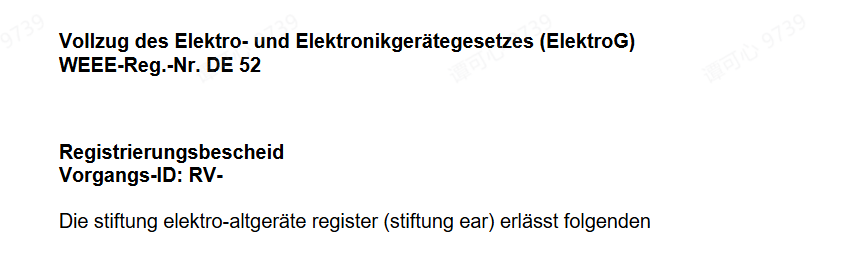
Example of a German WEEE registration notice issued by stiftung ear, showing where to find the WEEE registration number. Identifying details have been redacted.
Use your number and keep up with reporting. Include your WEEE registration number in sales offers and on invoices, and submit it to your marketplace if required. Make sure your products carry the required markings, report the quantities you place on the German market and maintain the financial guarantee or take-back arrangements that apply to your equipment.
What Happens If You Don’t Comply with Germany’s WEEE Rules?
Equipment that has not been properly registered cannot be placed on the German market. On Amazon.de, for example, the affected listings may be deactivated if you cannot provide a valid WEEE registration number that covers those products. Under Section 45 of ElektroG, certain infringements, including failing to register or failing to register on time, can carry fines of up to €100,000.
German WEEE Renewals and Annual Compliance
One of our group’s clients missed their German WEEE service renewal deadline and could no longer renew through the usual process. To continue selling in Germany, they would need to cancel their existing registration and apply again. In another case, Amazon gave a seller whose WEEE registration number had become invalid a deadline to submit a valid number to keep the affected listings live.
German WEEE registrations do not automatically expire at the end of each year. A renewal notice typically covers your authorised representative service, financial guarantee or other compliance services for the year ahead. If a required guarantee is no longer in place, the authority can revoke the registration.
If you miss your service renewal deadline, check whether you can still renew and whether your existing registration remains valid. If you need to apply for a new German WEEE registration, VATAi’s estimated processing time is 8–12 weeks. The actual timeline depends on whether your application is complete and how long the review takes.
If you purchased your German WEEE service through VATAi, log in and go to Renewal Services → EPR Services to see what is due for renewal. Check your order and renewal notice for the applicable deadline. After paying, confirm that your renewal has been processed and that any required financial guarantee and authorised representative arrangements are in place for the coming year.
Frequently Asked Questions (FAQ)
Q1: Can I use my supplier’s WEEE registration number on Amazon.de?
Yes. If you resell the equipment under its original brand and are not considered the producer under ElektroG. Ask your supplier for the upstream producer’s German WEEE registration number and verify that it covers the exact brand and equipment type you sell.
Q2: Can I use a WEEE registration from another EU country in Germany? No. WEEE registration is strictly country-specific. If you have producer registration obligations in Germany, you must obtain a separate German WEEE registration.
Q3: Does my German WEEE registration cover the battery in my product? No. Electrical equipment and batteries are governed by separate regulations. If your product contains or comes with a battery, you must check whether you also need a separate German battery registration.
Q4: Will my deactivated listings go live as soon as I get a new WEEE registration number? No. Submit the new registration number to Amazon for verification. Once Amazon verifies the number and your listings pass any additional checks, reactivate the affected listings in Seller Central.
Q5: Is paying the renewal fee enough to maintain my WEEE compliance? No. While the official registration itself does not expire, you must ensure your authorised representative contract and any required financial guarantee remain active for the coming year—otherwise, stiftung ear may revoke your registration number.