Amazon Europe Compliance Guide 2026: VAT, GPSR, EPR & PPWR
 VATAi Team
Selling on Amazon Europe gives brands access to major marketplaces such as Germany, France, Italy, Spain, the Netherlands, Poland, Sweden, Belgium and the UK. But Europe is no longer a market where sellers can list first and fix compliance later.
In 2026, Amazon Europe sellers need a clear compliance setup before inventory moves. This is especially true if you use FBA, Pan-European FBA, import goods from outside Europe, sell private-label products, or place packaged goods on the EU market after the PPWR application date of 12 August 2026.
This guide explains the main compliance requirements for Amazon Europe sellers: VAT, EORI and customs, GPSR product safety, EU Responsible Person requirements, EPR, PPWR packaging rules, batteries, WEEE and FBA documentation.
Quick Answer: What Compliance Do You Need to Sell on Amazon Europe?
Most Amazon Europe sellers should review seven compliance areas before launch.
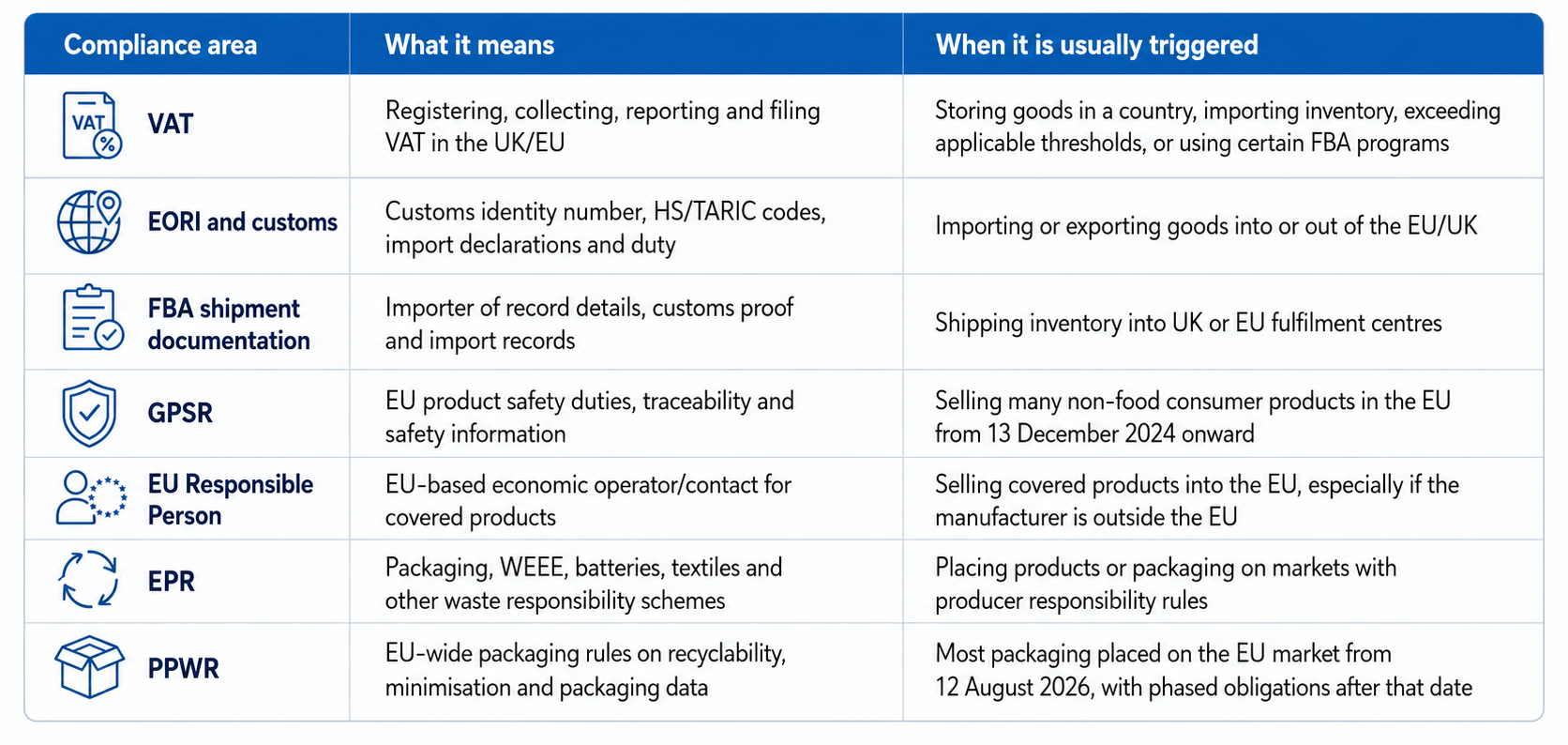
1. VAT Compliance for Amazon Europe Sellers
VAT, or value-added tax, is one of the first compliance topics Amazon Europe sellers need to address. If you import goods, store inventory in Europe, sell to EU or UK consumers, or enrol in certain FBA programs, you may need one or more VAT registrations.
Amazon's Europe guidance says sellers should consider tax and regulatory requirements, including VAT, when expanding into Europe. Amazon's EU VAT guidance also notes that local laws may require Amazon to hold VAT registration numbers for locations where sellers store inventory or exceed certain sales thresholds.
When Do Amazon Sellers Need VAT Registration?
You may need VAT registration if you:
● Store inventory in an Amazon fulfilment centre in the EU or UK.
● Import goods into the EU or UK for onward sale.
● Use FBA or Pan-European FBA and allow Amazon to move or store inventory across borders.
● Sell domestically from a local entity and exceed a domestic VAT registration threshold.
● Make eligible cross-border B2C sales above the EU-wide distance selling threshold, unless reported through OSS where available.
● Sell B2B across EU borders and need correct VAT/VIES handling for intra-EU transactions.
VAT is not only a checkout issue. It affects pricing, invoices, import VAT, customs documents, Seller Central settings and FBA storage decisions.
VAT and Pan-European FBA
Pan-European FBA can help Amazon place inventory closer to customers across Europe. That can improve delivery speed and reduce fulfilment costs, but it can also mean your goods are stored in multiple EU countries.
Before enabling Pan-European FBA, confirm:
● Which countries Amazon may store your inventory in.
● Whether you have VAT numbers for those countries.
● Whether your VAT calculation and invoice settings match your registrations.
● Whether EPR, packaging, battery or WEEE registrations are also required in those countries.
● Whether your business can handle local filing deadlines and record keeping.
If your stock is stored in Germany, France, Italy, Spain, Poland, the Czech Republic, the Netherlands or another EU market, local VAT registration may be required even if your customers are in other countries.
OSS, IOSS and Marketplace VAT
The EU One Stop Shop (OSS) can simplify certain eligible cross-border B2C VAT reporting. However, OSS generally does not replace local VAT registration where you store inventory.
The Import One Stop Shop (IOSS) is relevant to certain imported low-value B2C shipments. It is not a universal solution for bulk inventory imported into FBA warehouses.
In some marketplace-facilitated transactions, Amazon may be treated as the deemed supplier for VAT purposes. That does not automatically remove your obligations as importer, inventory owner, record keeper or VAT registrant. Treat marketplace VAT collection as one part of the workflow, not as a full compliance shield.
2. EORI, Customs and Import Compliance
VAT is only one part of the import process. Sellers bringing goods into Europe also need a customs workflow.
What Is an EORI Number?
An EORI number is the Economic Operators Registration and Identification number used for EU customs processes. The European Commission states that an EORI number is mandatory for customs clearance in the EU customs territory.
If you import goods into both the EU and the UK, you may need separate EU and UK customs setups because the UK uses its own customs system.
HS Codes, TARIC Codes and Duties
Each product needs the correct customs classification. In the EU, import declarations typically rely on commodity/TARIC codes based on the Harmonized System.
Correct classification affects:
● Customs duty rate.
● Import VAT calculation.
● Product restrictions.
● Anti-dumping duties.
● Documentation requirements.
● Whether additional product compliance rules apply.
Do not copy an HS code from a competitor listing. Validate it with your supplier, customs broker or trade advisor, especially for electronics, toys, textiles, cosmetics, batteries, food-contact materials and bundled kits.
Importer of Record and FBA Shipments
Before shipping to Amazon Europe FBA, decide who is responsible for import clearance. Your commercial invoice, EORI, VAT number, importer of record, delivery terms and customs broker instructions should match.
Keep a clean file for every shipment:
● Shipment ID.
● Commercial invoice.
● Packing list.
● Customs declaration.
● Duty and import VAT proof.
● Airway bill or bill of lading.
● Broker correspondence.
● Import Entry Number or equivalent customs reference where applicable.
Missing customs proof can create delays, stranded inventory or future account-level compliance friction.
3. GPSR Compliance and the EU Responsible Person
The General Product Safety Regulation, Regulation (EU) 2023/988, applies from 13 December 2024. It modernised EU product safety rules for consumer products, including products sold online and through marketplaces.
For Amazon sellers, GPSR is now a live compliance requirement, not a future deadline.
Who Needs GPSR Compliance?
GPSR generally applies to non-food consumer products placed on the EU market unless a more specific EU safety framework fully covers the product. Many Amazon categories can be affected, including household goods, electronics accessories, furniture, apparel, textiles, sports goods, baby products, toys, kitchenware and DIY products.
Category-specific rules may still apply on top of GPSR. For example, CE-marked products, toys, electronics, machinery, batteries, cosmetics and food-contact materials may have additional requirements.
What Amazon Sellers Should Prepare
At minimum, review whether each product has:
● A responsible economic operator in the EU where required.
● Manufacturer name, postal address and electronic contact details.
● EU Responsible Person or authorised representative details where applicable.
● Product identifiers such as type, batch, serial number or SKU-level traceability.
● Safety warnings and instructions in the correct local language.
● Risk assessment and technical/compliance documentation.
● Photos of product labels and packaging labels.
● A process for product safety complaints, recalls and authority requests.
Amazon may request manufacturer and Responsible Person information in Seller Central. The hard part is not entering the field; it is proving the label, packaging and documentation behind that field are consistent.
EU Responsible Person vs Authorised Representative
Sellers often use "EU Responsible Person" and "authorised representative" interchangeably, but they are not always the same legal role. The correct setup depends on the product category and applicable EU legislation.
For practical Amazon compliance, focus on the outcome: there must be an EU-based economic operator or contact where the rules require one, and that party must be able to perform the required tasks, keep documentation and respond to authorities.
If your manufacturer is outside the EU, do not assume Amazon, your freight forwarder or your FBA warehouse automatically becomes your Responsible Person.
4. EPR Compliance: Packaging, WEEE, Batteries and More
Extended Producer Responsibility, or EPR, shifts responsibility for waste collection, recycling and reporting to producers, importers and sellers. Amazon requires EPR registration numbers in certain countries and categories because marketplaces can face obligations around non-compliant offers.
Common EPR Categories for Amazon Sellers
EPR obligations often apply to:
● Packaging, including shipping boxes, product packaging, inserts and void fill.
● Electrical and electronic equipment, known as WEEE.
● Batteries and products containing batteries.
● Single-use plastics in certain countries.
● Textiles in countries with textile EPR schemes.
● Furniture, paper, tyres, oils or other country-specific categories.
Germany and France are two of the most important EPR markets for Amazon sellers. Germany commonly requires packaging registration through LUCID and system participation. France has multiple EPR streams, and sellers should not stop at packaging if they sell electronics, textiles, furniture, toys, sports goods, DIY goods, batteries or paper products.
5. PPWR 2026: EU Packaging Rules Start Applying on 12 August 2026
The Packaging and Packaging Waste Regulation, Regulation (EU) 2025/40, entered into force on 11 February 2025 and generally applies from 12 August 2026. The European Commission states that PPWR covers all packaging and packaging waste, regardless of material or origin, and sets requirements around manufacturing, composition, reusability, recoverability, waste management and prevention.
For Amazon Europe sellers, 12 August 2026 should be treated as a packaging compliance readiness deadline.
PPWR can affect:
● Product packaging.
● Retail packaging.
● Shipping cartons and mailers.
● Inserts, sleeves, labels and leaflets where they form part of the packaging system.
● Void fill, cushioning, tape and other transport packaging.
● Bundled or multipack packaging.
What Sellers Should Prepare Before 12 August 2026
Prepare SKU-level packaging data before inventory is produced or shipped:
● Material type for each packaging component.
● Packaging weight and dimensions by SKU.
● Supplier declarations for material composition.
● Recyclability evidence.
● Recycled content evidence where relevant.
● Packaging minimisation review, especially for oversized ecommerce packaging.
● Country-level EPR registration and reporting alignment.
● Disposal labels, environmental claims and sorting instructions checked against local rules.
For private-label sellers, PPWR should be built into product development and supplier contracts. Ask suppliers for packaging specifications before production, not after FBA shipment creation.
The practical risk is simple: you may have valid VAT and EPR registrations but still lack packaging-level evidence for recyclability, material composition or minimisation. That gap can make future Amazon compliance requests harder to answer and may increase relabelling or repackaging costs.
6. Batteries Regulation and Battery-Containing Products
The EU Batteries Regulation entered into force on 17 August 2023. The European Commission describes it as part of the EU's circular economy and zero pollution ambitions, with rules designed to reduce environmental impact across the battery lifecycle.
Amazon sellers should review battery obligations if they sell:
● Electronics.
● Toys with batteries.
● Beauty devices.
● LED products.
● Remote controls.
● Power banks.
● Rechargeable appliances.
● Products containing button cells or lithium batteries.
Battery compliance can affect registration, labelling, removability, recycling, transport documentation and product safety evidence. If a product contains a battery, treat it as a compliance category, not an accessory detail.
7. Product Category Compliance: Do Not Stop at VAT
Many sellers treat "Europe compliance" as VAT plus EPR. That is too narrow.
Depending on your product, you may also need:
● CE marking.
● EU Declaration of Conformity.
● REACH chemical compliance.
● RoHS compliance for electronics.
● Toy Safety Directive documentation.
● EMC, LVD or RED testing for electronic or radio products.
● Food-contact material declarations.
● Cosmetic Product Notification Portal steps.
● Textile fibre labelling.
● Local language manuals, warnings and safety instructions.
If your listing was approved in the US, that does not mean it is ready for Amazon Europe. EU product compliance should be checked at ASIN/SKU level, not just brand level.
8. A Practical 12-Week Amazon Europe Compliance Launch Plan
Use this timeline before your first shipment.
Weeks 1-2: Market and Product Mapping
- Choose your first markets: Germany, UK, France, Italy, Spain or the Netherlands.
- Decide whether to launch with EFN, local FBA, Pan-European FBA, FBM or a 3PL.
- Map every SKU by product category, HS/TARIC code and compliance requirement.
- Check whether products need CE, GPSR, WEEE, batteries, textile, packaging or other category compliance.
- Identify manufacturer, importer, brand owner and Responsible Person roles.
Weeks 3-4: VAT, EORI and Import Setup
- Apply for VAT registrations needed for inventory storage and imports.
- Apply for EU and/or UK EORI numbers where needed.
- Confirm importer of record responsibilities.
- Align commercial invoice templates, Incoterms and customs broker instructions.
- Start PPWR packaging data collection if goods will be sold in the EU on or after 12 August 2026.
Weeks 5-6: Product Safety and Label Readiness
- Appoint the required EU economic operator or Responsible Person.
- Prepare safety documentation, risk assessments and certificates.
- Translate warnings, instructions and manuals into target-market languages.
- Update product labels, packaging labels and online listing compliance fields.
- Photograph labels and packaging before shipment.
Weeks 7-8: EPR and Packaging Registrations
- Register packaging EPR in required countries.
- Register WEEE, batteries, textiles or other category schemes where applicable.
- Add registration numbers to Seller Central where Amazon requests them.
- Set up reporting calendars and data collection for units, weights and materials.
- Align packaging material data with PPWR readiness and country EPR reporting.
Weeks 9-10: Seller Central Checks
- Enter VAT numbers by country in Seller Central.
- Confirm VAT calculation settings and invoice settings.
- Add GPSR manufacturer and Responsible Person information.
- Upload product compliance documents.
- Validate EPR registration numbers.
- Confirm localized titles, bullet points, manuals and safety warnings.
Weeks 11-12: Shipment and Go-Live
- Ship only after VAT/EORI/customs setup is ready.
- Keep customs declarations, import references, airway bills and duty/VAT proof.
- Monitor FBA receiving, listing status and compliance notifications.
- Run a small first shipment before scaling.
- Review account health and compliance dashboards after products become active.
Amazon Europe Compliance Checklist
Before launch, confirm:
- VAT registrations are in place for every country where inventory will be stored.
- OSS/IOSS applicability has been reviewed for cross-border sales.
- EU and/or UK EORI numbers are ready if import activities are involved.
- GPSR applicability has been assessed at SKU level.
- EU Responsible Person or economic operator details are valid where required.
- Product and packaging labels include required traceability and contact information.
- Local language warnings, instructions and manuals are prepared where applicable.
- EPR registrations are completed for packaging and applicable product categories.
- Battery, WEEE, textile, single-use plastic or other country-specific EPR schemes are checked.
- PPWR packaging data is collected before the 12 August 2026 application date.
- Seller Central VAT, EPR and product compliance fields are complete.
- Compliance evidence files are stored by ASIN/SKU for future checks.
What Happens If You Do Not Comply?
Non-compliance can affect both your Amazon account and your offline legal exposure. Common consequences include:
● Suppressed listings.
● Blocked ASIN creation.
● FBA shipment rejection or delays.
● Stranded inventory.
● Inability to create new shipments.
● VAT assessments, penalties or interest.
● Customs delays or seizure.
● EPR enforcement fees.
● Product safety takedowns or recall obligations.
● Account health warnings or suspension.
The biggest risk is operational: inventory is already in production or in transit, but a VAT number, EPR registration, customs document, GPSR label or PPWR packaging file is missing. Fixing compliance after stock arrives is slower and more expensive than building it into the launch plan.
How VATAi Helps Amazon Europe Sellers
VATAi helps ecommerce sellers prepare for European expansion with practical compliance support across VAT, EPR and product compliance workflows.
Depending on your launch plan, VATAi can help you:
● Assess VAT registration needs for the UK and EU.
● Coordinate VAT registration and filing support.
● Review EPR obligations for packaging and product categories.
● Support Germany LUCID, France EPR and other country registrations.
● Arrange EU Responsible Person support for GPSR workflows.
● Build a compliance roadmap before FBA or Pan-European FBA launch.
● Prepare a PPWR packaging data checklist before the 12 August 2026 application date.
If you are planning to sell on Amazon Europe, do not wait until Amazon sends a compliance notice. Start with a structured review of your products, markets, fulfilment model and inventory locations.
FAQs About Amazon Europe Compliance
Do I need a European company to sell on Amazon Europe?
Not always. Businesses outside Europe may be able to sell on Amazon Europe without forming a European company. However, they may still need VAT registrations, EORI/customs setup, an importer of record, EPR registrations and an EU Responsible Person depending on product and fulfilment model.
Do I need VAT registration if Amazon collects VAT?
Marketplace VAT collection does not automatically remove your need to register for VAT where you import or store goods. FBA inventory storage is a common local VAT trigger.
Does OSS replace local VAT registration for FBA sellers?
No. OSS can simplify eligible cross-border B2C VAT reporting, but it generally does not replace local VAT registrations required because your inventory is stored in a country.
Does Pan-European FBA require VAT in multiple countries?
Usually, yes. If Amazon stores your stock in multiple EU countries, you may need VAT registrations in those countries. Confirm the exact storage countries before enabling the program.
What is GPSR for Amazon sellers?
GPSR is the EU General Product Safety Regulation. It applies from 13 December 2024 and sets product safety, traceability, online marketplace and economic operator requirements for many consumer products sold in the EU.
Do I need an EU Responsible Person for Amazon Europe?
If your product is covered by rules requiring an EU-based responsible economic operator, you need a valid EU contact/entity for those responsibilities. Non-EU manufacturers and sellers should check this before listing or shipping inventory.
What is PPWR and when does it apply?
PPWR is the EU Packaging and Packaging Waste Regulation. It entered into force on 11 February 2025 and generally applies from 12 August 2026. Amazon Europe sellers should prepare packaging material data, recyclability evidence, packaging minimisation checks and EPR-aligned reporting before that date.
Does PPWR replace packaging EPR registration?
No. PPWR creates EU-wide packaging rules, while EPR registration and reporting still operate through country-level producer responsibility systems. Amazon sellers should prepare for both PPWR-ready packaging evidence and local EPR registrations where required.
What EPR registrations do Amazon sellers need?
At minimum, many sellers need packaging EPR in countries where they place packaged goods on the market. Depending on your product, you may also need WEEE, batteries, textiles, furniture, paper, single-use plastics or other country-specific registrations.
What documents should I keep for Amazon Europe compliance?
Keep VAT certificates, EORI confirmations, customs declarations, import VAT/duty proof, shipment records, supplier invoices, product test reports, Declarations of Conformity, risk assessments, label photos, translations, EPR certificates, packaging specifications, PPWR evidence files and Seller Central submission screenshots.
Need Help with VAT Compliance?
Book a free call with VAT Ai today to find tailored solutions for your e-commerce business
